
via: balogh
Notes:
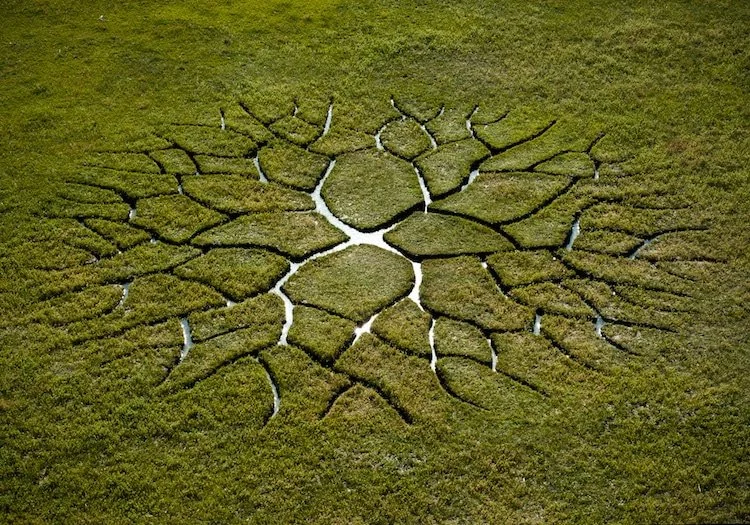
Krisztián Balogh’s artistic process begins with close observation of nature and a willingness to treat the landscape as both material and collaborator. In his 2012 earthwork World Tree, Balogh carved an intricate, branching design into a peat bog and allowed water to fill the channels. Rather than placing a separate object within the environment, he reshaped the ground itself, creating a work that appears to grow organically from the site. This approach gives the landscape an active role, since soil, water, light, and reflection continually influence the sculpture’s appearance. Inhabitat
Balogh’s process is especially compelling because it balances careful geometric planning with the unpredictable behavior of natural materials. Measuring approximately thirty-two feet across, World Tree transforms the familiar structure of roots, branches, and rivers into an almost abstract network. When viewed from above, the work resembles a diagram of circulation—a form through which water, energy, and life might travel. Yet its visual precision can also create emotional distance; the strongest photographs make the earthwork appear digitally produced, potentially obscuring the physical labor, instability, and environmental conditions involved in its construction.
The temporary nature of Balogh’s work is essential to its meaning. Water evaporates, vegetation returns, and the carved ground gradually changes, preventing the sculpture from becoming a fixed monument. This impermanence encourages viewers to consider nature as an evolving system rather than a passive surface available for human control. Balogh’s process is most successful when this tension remains visible: the artist imposes a symbolic order upon the land, while the land slowly resists, transforms, and absorbs that intervention. Through this exchange, his work becomes a meditation on creation, mortality, and humanity’s fragile relationship with the natural world.
- RJG//AI