
via: heizer
Notes:
Michael Heizer’s artistic process treats the earth not merely as a location but as the central material of the artwork. Rather than producing sculptures that can be placed inside galleries, Heizer excavates, cuts, displaces, and reorganizes soil and stone on a monumental scale. In works such as Double Negative, the removal of earth becomes an act of creation: the empty space between two enormous trenches functions as the sculpture itself. His process encourages viewers to recognize absence, distance, and negative space as physical experiences rather than abstract ideas.
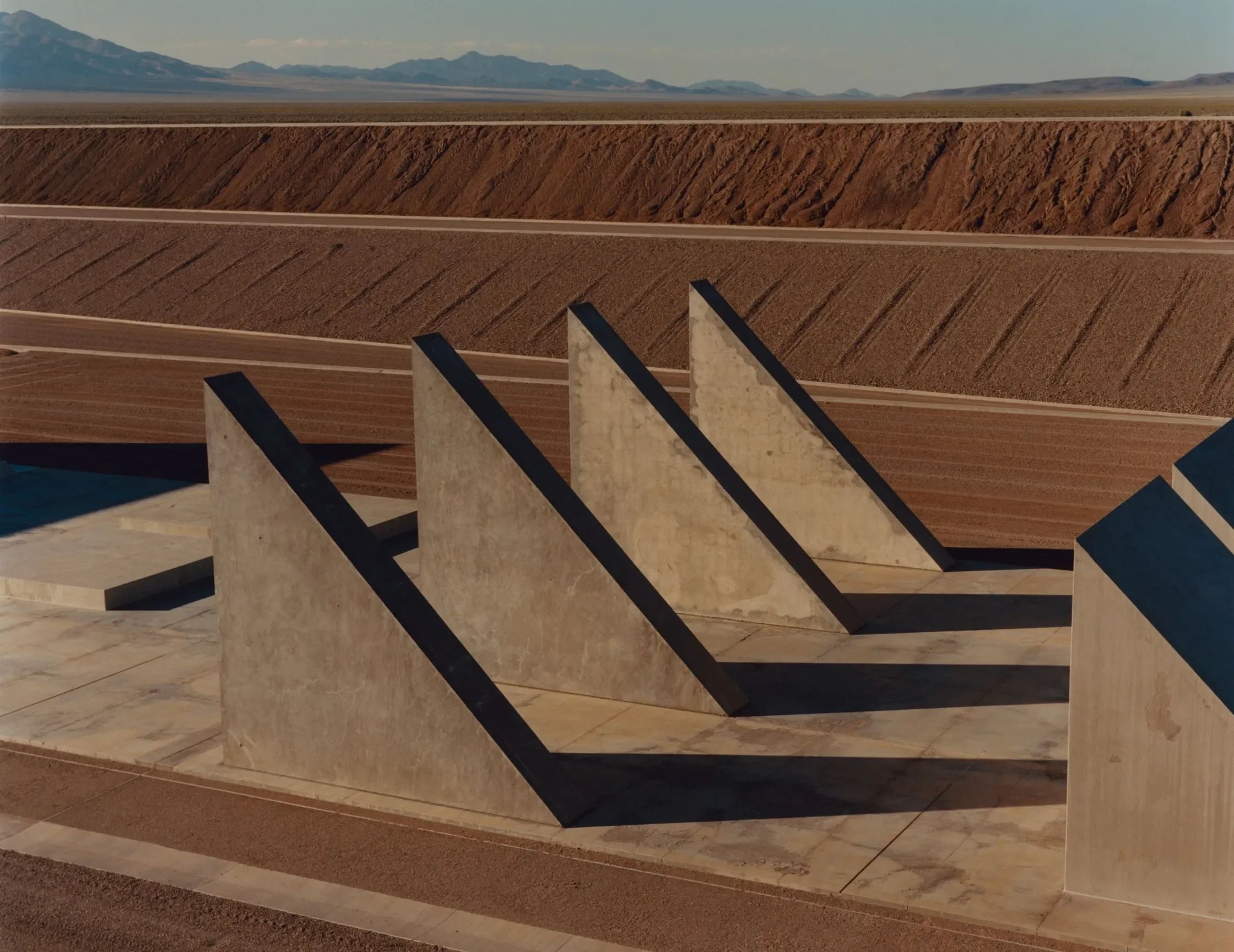
A defining quality of Heizer’s process is the relationship between raw geological materials and modern engineering. Heavy machinery, precise measurements, architectural planning, and large teams are required to construct works that often resemble ancient monuments or ceremonial sites. His decades-long project City demonstrates this commitment through massive earthen formations and geometric concrete structures built within the Nevada desert. The slow development of the work allows time, weather, gravity, and the surrounding landscape to participate in its meaning, making the process feel both industrial and archaeological.
Heizer’s Earthworks are powerful because they place human ambition against the immense scale of nature and geological time. At the same time, the excavation and alteration of land raise important environmental and ethical questions. His work can be interpreted as a critique of humanity’s desire to control the landscape, but it also participates directly in that control through construction and displacement. This contradiction gives Heizer’s process its lasting complexity: his Earthworks inspire wonder while asking whether a permanent human mark upon the land represents reverence, domination, or an uneasy combination of both.
- RJG//AI